
Executive Summary
Enterprise AI ownership determines whether intelligence AI systems generate accumulates on enterprise balance sheets or vendor infrastructure. Most enterprises deploy AI on Systems of Record; CRMs, ERPs, and compliance platforms designed to store operational data, not make it accessible for AI reasoning.
This architectural gap explains why 88% of organizations pilot AI but only 7% scale it enterprise-wide. Systems of Context enable autonomous context capture and AI-native architecture, allowing intelligence to compound inward with every interaction.
MCP-ready infrastructure makes operational intelligence directly accessible to AI, ensuring capability builds permanently within owned systems rather than externalizing through vendor relationships.
Key Takeaways:
- Enterprise software was built to store operational data, not make it accessible for AI reasoning; a design decision now costing enterprises competitive advantage as AI adoption scales.
- This resulted in a structural intelligence gap where 88% of organizations pilot AI but only 7% scale it enterprise-wide.
- Vendor dependencies extract intelligence from enterprises across four dimensions: operational, political, data, and strategic, compounding institutional capability on external balance sheets rather than internal infrastructure.
- Systems of Context enable autonomous context capture and AI-native architecture, allowing intelligence to compound inward with every interaction rather than resetting across sessions.
- Hyper delivers MCP-ready infrastructure from deployment, making sovereign intelligence architecture the default for enterprises building owned systems that reason, not just store.
For decades, enterprise software has been architected around a single objective: capture what an enterprise does. Transactions are stored, interactions logged, decisions recorded, producing systems that are deeply embedded and widely trusted, yet structurally limited in what they can offer to AI-driven operations.
The constraint is not data scarcity. Most enterprise systems today hold operational data accumulated across years of execution. The problem is that the intelligence encoded in that data; the relationships, the patterns, the context, and the meaning, remains inaccessible to the AI systems that need it to reason.
Enterprise software was designed to store what happened. It was never designed to make what happened intelligible to systems that must reason about what happens next.
That design limitation, data stored for retrieval, not reasoning, compounds at scale. Intelligence does not accumulate toward the enterprise. It remains fragmented, session-bound, or externalized across the systems used to process it. What appears as an AI adoption or scaling challenge is, in practice, a question of where intelligence resides and who controls its ability to compound.
What Enterprise AI Ownership Actually Means: The Intelligence Accumulation Question
Ask a CTO which AI tools their organization is running. The answer comes quickly. Ask who owns the intelligence those tools generate. Most will pause.
Ownership of the intelligence itself. The reasoning, the pattern recognition, the decision logic embedded in every workflow the enterprise depends on. Where does it live, who controls it, and what happens to it when the vendor contract ends?
The dominant systems underpinning most U.S. enterprises; CRMs, ERPs, compliance platforms, are Systems of Record built to answer one question: what happened. But when AI needs to reason about what happens next, those systems fall short. The question becomes: who owns the intelligence required to close that gap?
Enterprise AI ownership requires a different architecture.
Adoption metrics suggest momentum. 88% of organizations now use AI in at least one business function. Only 7% have fully scaled it enterprise-wide (McKinsey, 2025). The constraint is not access to data. It is the absence of context. Systems of record retain history but do not encode meaning in a form AI can reason over.
Most enterprises address this gap by extracting operational context and sending it to vendor infrastructure for AI processing. Intelligence accumulates there, not within systems the enterprise controls.
Enterprise AI ownership inverts that pattern: reasoning, decision logic, and operational intelligence remain within infrastructure the enterprise governs directly. Without that condition, intelligence does not compound inward. It accumulates elsewhere.
The absence of ownership results in dependency, and in enterprise AI it manifests in four distinct forms.
Enterprise AI Vendor Lock-In: The Four Forms of Structural Dependency
Vendor lock-in in enterprise AI accumulates through four structural dependencies, each one a mechanism through which intelligence is externalized from infrastructure the enterprise believes it controls.
Operational Dependency
It places execution under external discretion. Uptime, rate limits, and pricing models define what the enterprise can build and sustain. Engineering adapts to API constraints rather than business requirements, placing core capability under external discretion.
Political Dependency
It shifts product direction outside the enterprise. Features and access are governed by vendor roadmaps, and when vendor policies change, internal workflows realign to fit external decisions.
Data Dependency
It transfers operational context outward with every interaction. Every inference carries domain-specific intelligence into vendor-controlled systems. The model compounds in capability. The enterprise does not.
Strategic Dependency
It makes adaptation conditional. Customization and architectural evolution require alignment with vendor-controlled foundations. Architectural limits are discovered only after they have been embedded into enterprise operations.
Each dependency is reversible at the system design stage. Once operationalized, reversal requires rearchitecting under live conditions, where cost, risk, and disruption increase non-linearly. As a result, capability funded by the enterprise compounds outside it, accruing to the vendor’s balance sheet, rather than enterprise’s operational infrastructure.
These dependencies persist because of an architectural misalignment between how enterprise systems store intelligence and how AI systems must access it.
The Intelligence Gap: Why Systems of Record Produce Data Without Context
Enterprise hold more operational data than ever before and have less operational clarity than they need. It is the direct consequence of building archaic systems that act as repositories, lack contextual understanding, and are fundamentally ill-equipped to support dynamic, AI-driven decision-making.
A CRM can retrieve every customer interaction. It cannot tell AI what that pattern means or what action it suggests. Data stored in schemas designed for human navigation does not become usable context for AI.
The gap between retrieval and reasoning is architectural. As AI becomes more embedded in enterprise workflows, competitiveness increasingly depends on the gap between what data systems contain and what AI can actually reason about.
That gap exists because of a foundational architectural distinction between two categories of enterprise software: Systems of Record and Systems of Context.
System of Record vs. System of Context: The Core Architectural Distinction
A System of Record answers: what happened. A System of Context answers: what does ‘what happened’ mean, and what should happen next. The distinction determines where intelligence accumulates.
System of Record
In a System of Record, operational context must be manually extracted, structured, and sent to vendor-controlled infrastructure for AI reasoning. This is the vendor lock-in pattern: enterprises fund intelligence development that accumulates on external balance sheets.
With every inference, the vendor’s model becomes more capable of reasoning about patterns specific to the enterprise’s operations; credit risk profiles, supply chain bottlenecks, customer behavior anomalies. That capability remains with the vendor. The enterprise funded its development. The vendor captured its value. This is the architecture most enterprises have deployed AI on top of.
The alternative is an architecture where intelligence compounds inward from the first line of code.
What is a System of Context in Enterprise AI
A System of Context is the alternative architecture. Where a System of Record stores data in predefined schemas, a System of Context understands the relationships, history, intent, and situational relevance of that data in real time. It is an AI-native enterprise architecture designed to make operational intelligence directly accessible to AI, without human translation layers and without intermediary vendor infrastructure.
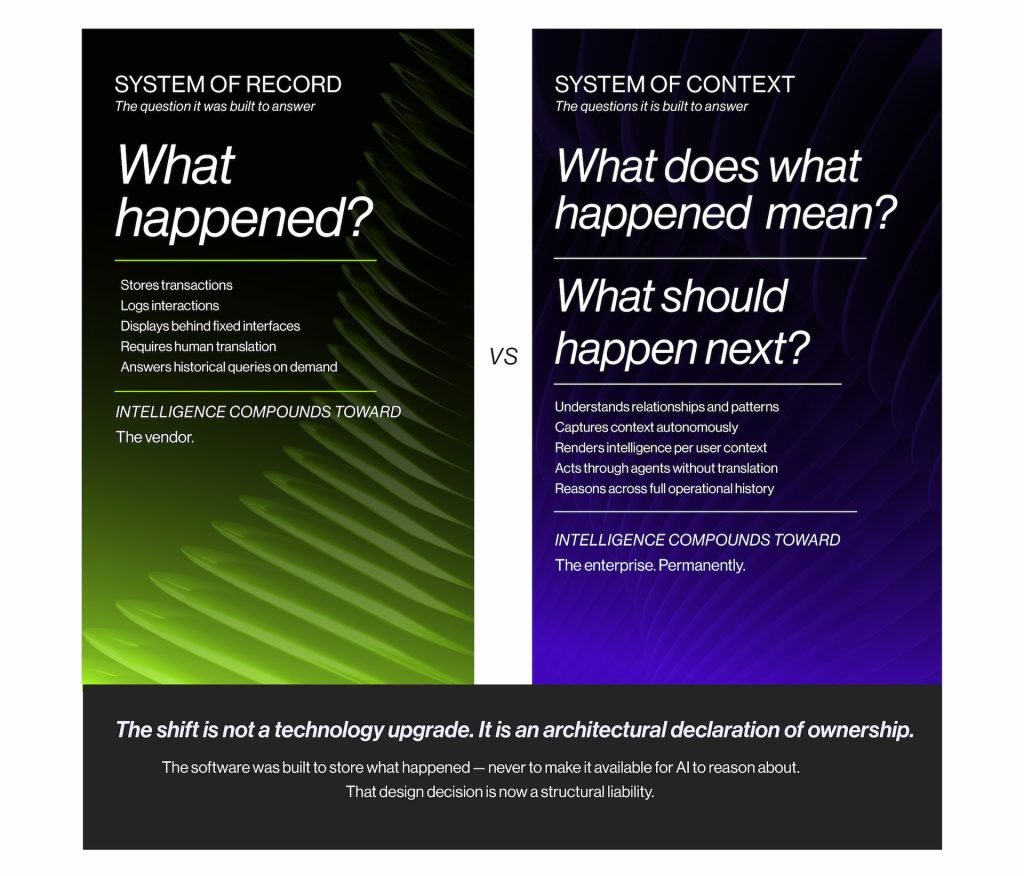
Diagnosing System Architecture – System of Record vs System of Context
The diagnostic that reveals which architecture an organization has is straightforward: how does context enter the system?
In most enterprise deployments, context entry is manual. A salesperson logs a call summary into the CRM. A compliance officer copies transaction details into a case management system. A supply chain analyst updates inventory notes in an ERP.
The knowledge workers translate operational reality into structured fields the system requires. The AI analyses what was stored. The architecture remains a System of Record with an AI layer on top.
In a System of Context, context entry is autonomous. The system captures operational intelligence from its original source; communications, transactions, interactions, without requiring human translation.
The conversation happened. The system understands what was discussed, what commitments were made, what changed, and what action the pattern suggests. That is AI-native architecture. The intelligence compounds inward. Every interaction makes the system more capable of reasoning about the operational reality of the organization that built it.
At maturity, that depth cannot be purchased from a vendor. It accumulates only through operational use, inside infrastructure the enterprise controls.
The question facing enterprise leaders is whether the intelligence AI generates will compound on their balance sheet or vendor’s. That distinction determines competitive position.
Learn More: Download our whitepaper for a deep dive into Understanding and Deploying Systems of Context
Sovereign Intelligence and Compounding Competitive Advantage
The enterprises pulling ahead in AI compound intelligence differently than their competitors. Their systems generate intelligence that accrues permanently on their own balance sheet.
This is sovereign intelligence: AI operating within infrastructure the enterprise governs, shaped by its policies, and strengthened through continuous operational use, with no dependency on external vendors.
The advantage is architectural. A credit decisioning system internalizes edge cases aligned to an institution’s risk appetite. A compliance platform recognizes patterns distinguishing legitimate activity from emerging threats. That specificity accumulates inside infrastructure the organization controls.
This form of intelligence cannot be licensed or retrofitted. It is built through use, over time, inside owned architecture.
The MCP-Native Architecture That Enables Sovereign Intelligence
Building sovereign intelligence requires two architectural components.
The first is MCP (Model Context Protocol), the open standard that makes internal systems directly readable and actionable by AI agents. When a system is MCP-ready, AI accesses the full operational context of the enterprise directly. No intermediary layers. No vendor APIs. No permission required from external platforms.
The second is a platform that generates Systems of Context by default, with every system MCP-ready from deployment. Hyper is designed on this principle. The database structure, the business logic, the security model, and the integration layer are generated using components the organization owns permanently.
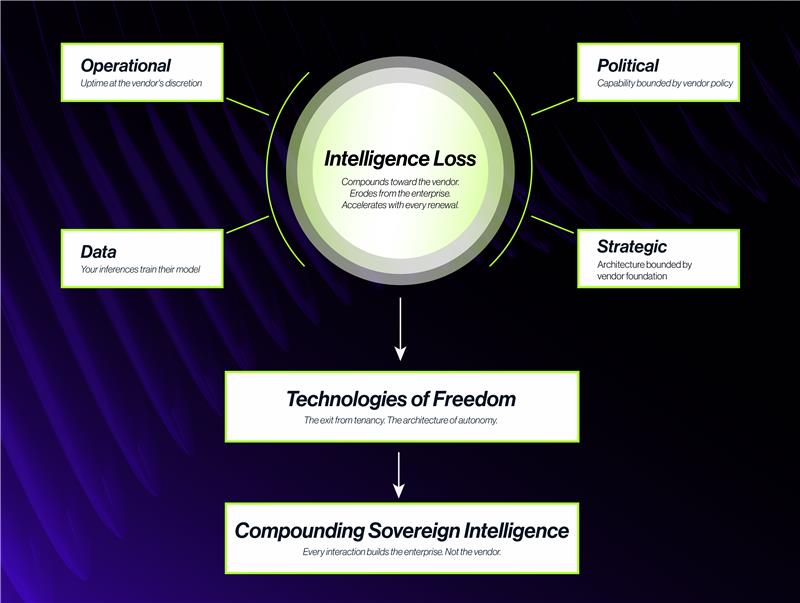
Hyper is built on open-source foundations no single vendor controls, the architecture of autonomy called Technologies of Freedom. Security hardened for enterprise deployment. Institutional knowledge embedded from the first line of code. Infrastructure owned permanently by the organization that builds on it, not hosted on systems that can be repriced, restricted, or withdrawn.
The Exit from Tenancy
For decades, enterprises have built on intelligence they never owned. Every workflow improvement, every operational pattern, every exception learned through experience; captured in systems controlled by vendors, compounding on balance sheets that are not theirs.
The architectural decisions available today change that equation. Open foundations that no single vendor controls. MCP-native systems that make operational intelligence directly accessible to AI. Owned infrastructure where every inference compounds toward the organization running it. These are not aspirational capabilities. They are available now, to any enterprise willing to treat intelligence as infrastructure rather than as a service.
The competitive question has shifted. It is no longer which AI systems are in use. It is where the intelligence they generate accumulates. Systems of Record will continue to capture activity. Systems of Context will determine meaning and action for AI-driven decision making.
The distinction is structural. The decision remains open. The window in which it is still a choice is narrowing. The exit from tenancy is an architectural decision. It is available now.
Ready to own the intelligence your operations generate? Hyper Beta is open to research and engineering organizations. Apply here.
Frequently Asked Questions
What is enterprise AI ownership?
Enterprise AI ownership determines whether the intelligence AI systems generate; reasoning capability, pattern recognition, decision logic, accumulates within infrastructure the enterprise governs or resides on vendor-controlled platforms where capability compounds externally.
What is the difference between Systems of Record and Systems of Context?
System of Record vs. System of Context – Architectural Comparison
| Dimension | System of Record | System of Context |
| Primary Question Answered | What happened? | What does it mean? What happens next? |
| Data Architecture | Predefined schemas for storage | AI-native structure for reasoning |
| Context Entry | Manual (human translation required) | Autonomous (direct operational capture) |
| Intelligence Accumulation | Externalized to vendor infrastructure | Compounds inward to owned systems |
| AI Access Pattern | Extract → structure → send to vendor | Direct reasoning over live data |
| Reasoning Capability | None (storage only) | Native (understands relationships, intent, history) |
| Vendor Dependency | High (reasoning layer vendor-controlled) | None (MCP-ready, open foundations) |
| Competitive Advantage | Transient (vendor can serve competitors) | Compounding (facility-specific intelligence) |
| Example Systems | Traditional CRM, ERP, compliance platforms | Hyper-built MCP-native applications |
| Intelligence Ownership | Vendor balance sheet | Enterprise balance sheet |
What is sovereign intelligence in enterprise AI?
Sovereign intelligence in enterprise AI is when AI systems operate within infrastructure the organization governs, with capability strengthening through continuous operational use and zero vendor dependency. Unlike vendor-hosted AI, intelligence accumulates permanently within owned systems rather than externalizing to external balance sheets.
How does Hyper enable sovereign intelligence?
Hyper generates MCP-native Systems of Context by default, with database structure, business logic, and security model using open-source components organizations own permanently. Unlike vendor-hosted platforms, intelligence compounds within enterprise infrastructure from first deployment, not on external vendor balance sheets.
Can we convert existing Systems of Record into Systems of Context?
Converting Systems of Record to Systems of Context requires rearchitecting data layers for AI-native access patterns. Most enterprises build Systems of Context for new AI workflows (8-12 week deployment) while maintaining Systems of Record for historical data retrieval and regulatory compliance.
Does sovereign intelligence require building everything in-house?
No. Sovereign intelligence requires owned infrastructure and open-source foundations, not custom development. Platforms like Hyper use composable, vendor-independent components organizations control permanently while accelerating deployment through pre-built MCP-native architecture, eliminating 18-24 month enterprise AI vendor timelines.
What skills do teams need for building Systems of Context?
Building Systems of Context requires standard application development skills. Platforms like Hyper generate MCP-ready architecture automatically, allowing teams to focus on business logic and operational workflows rather than protocol implementation or model orchestration complexity.
Bibliography
- McKinsey & Company. “The State of AI in 2025: Agents, Innovation, and Transformation.” McKinsey QuantumBlack, November 2025. https://www.mckinsey.com/capabilities/quantumblack/our-insights/the-state-of-ai.